

LabVIEW Training
I should have taken this class 15 years ago.
Dan P. | Assured Space Access Technologies
One of the best instructors I have ever had.
Ryan S. | General Dynamics
I actually learned some new things even after 10 years of working with LabVIEW.
Joao A. | Natural Resources Canada
Far exceeded all other training courses I have ever enrolled in.
Rouble C. | Manufacturing Engineer
Sixclear's course covered the full gamut.
John P. | Florida Turbine Technologies
All phases of the course were excellent, I found it to be just what I was looking for.
Russell L. | Schlumberger
The material is very valuable, clear, and very well structured.
Jose L. | Verdtech
This class brought me to the next level.
Dan P. | Assured Space Access Technologies
The instructor's teaching method from start to finish was exemplary.
Rouble C. | Manufacturing Engineer
Clear, concise, knowledgeable, and easy to understand.
Ryan S. | General Dynamics
Really complete and easy to understand.
Joao A. | Natural Resources Canada
The instructor's teaching method from start to finish was exemplary.
Russell L. | Schlumberger
The course material is excellent and persists beyond the class.
Dan P. | Assured Space Access Technologies
It was more than I expected for a five day training course.
Rouble C. | Manufacturing Engineer
I feel much more confident with LabVIEW and better understand its potential.
Ryan S. | General Dynamics
Philosophy
Hands-on training to truly comprehend, so you can tackle any challenge
Live Demos, Write Code, No Slides
Our training courses are unlike any other courses in the world.
There are essentially no slides - they lack the dynamic of live programming.
You will NOT be reading from manuals, ever - that's inefficient and ineffective.
Instead, we begin from first principles and build up clear, foundational mental models.
We then demonstrate those concepts by live programming from scratch in the language/environment of focus.
At each stage you'll have time to develop practical, working code to cement your comprehension and skills.
And we'll conquer everything together with low stress, high energy, and infectious intellectual curiosity.
So Much Technology, We Get It
There are a dizzying number of ways to learn new skills in software engineering today.
The pace of software innovation has accelerated since the mid-sixties, and now every segment of the economy
relies on software to execute their operations and enable the next generation of innovation. With the sheer scope of
software tools, languages, and processes, it can be overwhelming for anyone to know where to dedicate time and energy to grow their skills.
We have dedicated ourselves to ensuring you walk away with the skills you need to tackle real-world challenges.
Not Just Theory, It Has To Work
We understand you need to apply the skills you learn - directly to your work.
We work with many of the Fortune 500 automating R&D and production processes, and help guide
our national laboratories on how to best apply software solutions to their scientific and engineering efforts.
Our architect-level instructors bring that experience and expertise to the classroom to help you apply new software skills directly to your applications and projects.
LabVIEW Training
The best LabVIEW training on the planet (we really mean it)
LabVIEW (and the underlying language G) is the industry-leading platform for developing industrial test, monitoring, control, and automation systems. And Sixclear is the industry leader in LabVIEW training, staffing only architect-level engineers to teach all its courses. As with all our courses, we apply our world-renowned approach: there are essentially no slides and you won't be reading from exercise manuals. You're here to learn as much as possible in order to conquer challenges at work and help usher in the next generation of technology. To do that, you need deep, hands-on experience and an instructor who lends perspective from decades of experience. Check out our LabVIEW courses below and join us for a immersive, energetic, fun experience - and learn some incredible skills along the way!
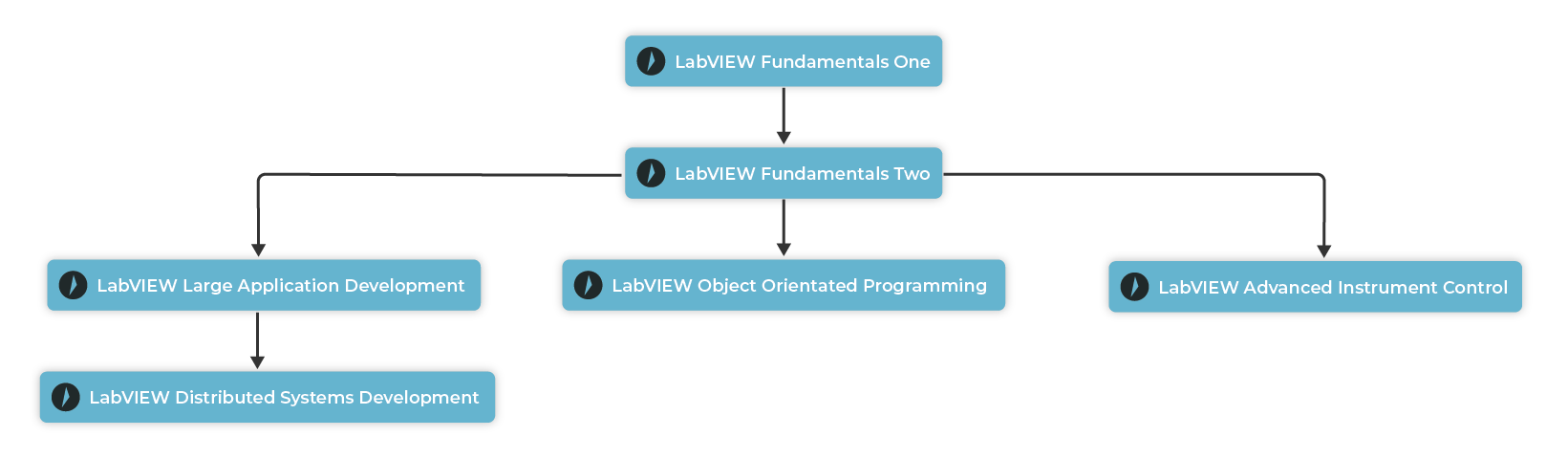
Course Prerequisite Tree
LabVIEW Fundamentals One
Duration: 3 days
Purpose: to deep-dive into LabVIEW and empower you to efficiently create and modify robust applications in LabVIEW incorporating real-world data.
After completing this course you'll be able to develop small applications from scratch and modify key aspects of medium-sized applications.
Topics: the fundamentals of programming, the dataflow paradigm, data types, arrays, loops, case (and other) structures, subVIs (functions in LabVIEW), file I/O, error handling, state machines, and much more.
There's much more here than in a typical first course in LabVIEW!
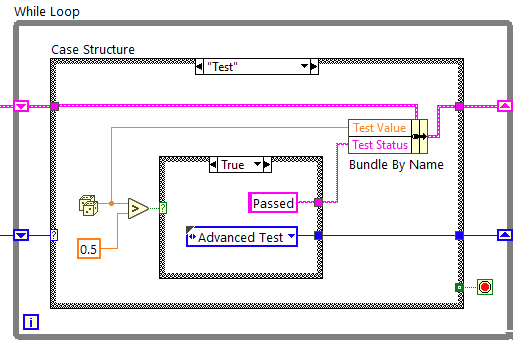
LabVIEW Fundamentals Two
Duration: 2 days
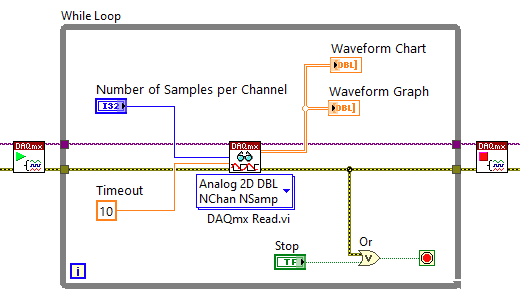
Purpose: to take a giant leap forward in LabVIEW for developing and deploying standalone applications incorporating more sophisticated design patterns, data acquisition, instrument control, and more.
After completing this course you'll be able to develop medium-sized applications from scratch and modify key aspects of large applications.
Topics: advanced event handling, design patterns such as producer-consumer, variables, type definitions, advanced file I/O, property & invoke nodes (and VI Server in general), data acquisition (ex. DAQmx), instrument control (ex. NI-VISA), executables and installers, and much more.
This will all be easier than perhaps it sounds as we carefully break down the topics and compose practical applications together during exercises.
LabVIEW Advanced
Duration: 3 days
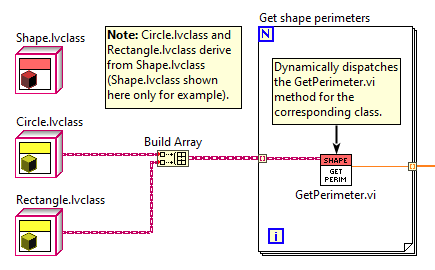
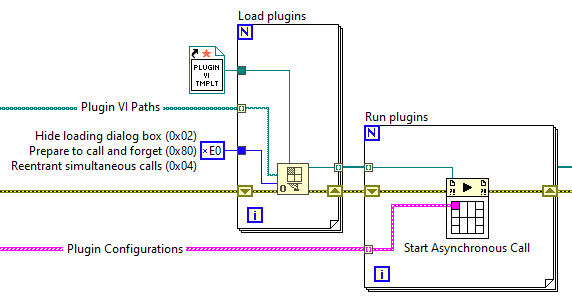
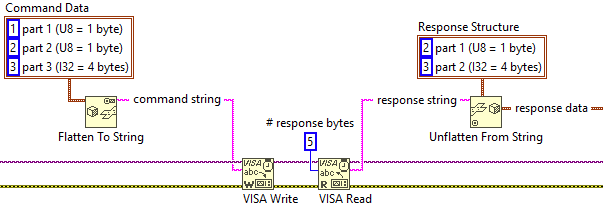
Purpose: to acquire the skills to build scalable, extensible, maintainable applications using object oriented programming (OOP), asynchronous and plugin architecture deployment patterns, advanced instrument control including binary protocol handling strategies, and much more.
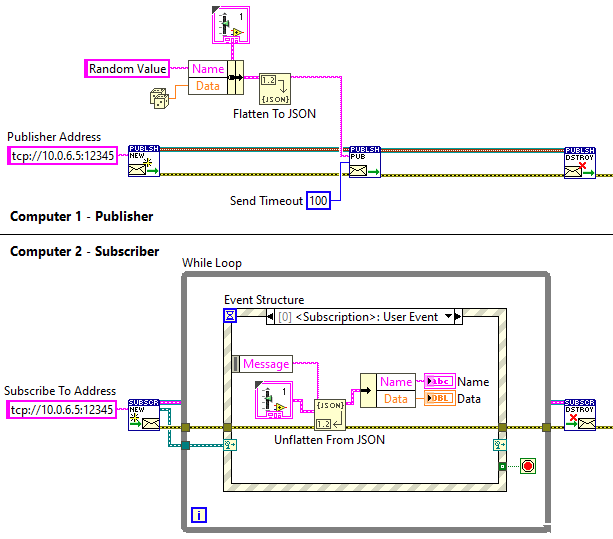
Topics: LabVIEW classes (including key concepts of encapsulation, reuse, inheritance, dynamic dispatch, dynamic loading, and more), calling VIs by reference, spawning asynchronous instances, plugin architectures, JSON configuration and messaging, data value references, network protocols including UDP, TCP, HTTP, and much more.
Pricing
We deliver on your investment to master LabVIEW
We're going to be frank about this: we take your investment in LabVIEW training very seriously, and we believe we are the best training organization in the world.
Why? Well, we have over 2 decades of experience, we staff only architect-level engineers, and we are passionate about helping others learn LabVIEW.
Standard Pricing
| Course (click for description) |
Duration (days) |
Live Instructor (Web Conference) |
Online Videos (Self-paced) |
|---|---|---|---|
| LabVIEW Fundamentals One | 3 days | $1799 (Buy) | $299/yr (Try | Buy) |
| LabVIEW Fundamentals Two | 2 days | $1299 (Buy) | $299/yr (Try | Buy) |
| LabVIEW Fundamentals One & Two Bundle | 5 days | $2799 (Buy) | $549/yr (Try | Buy) |
| LabVIEW Fundamentals One & Two Student Discount | 5 days | Call | $249/yr (Try | Buy) |
| LabVIEW LabVIEW Advanced | 3 days | $1999 (Buy) |
Enterprise Training Engagements
Many organizations and enterprises call on us to deliver courses, and often that means multiple courses a year on a schedule that meets the needs of their staff.
Contact us anytime to discuss how we can help ensure your staff have the skills to deliver real value to your organization.
Custom Courses
Unlike many shops, we don't need to spend weeks or months developing curriculum for a custom course. One benefit of having a staff of architect-level engineers, plus having delivered endless courses, is that we have training modules for just about any custom course in our arena. Contact us anytime to discuss how we can quickly deliver on your custom training needs.
Schedule
Hold your spot in any class at no cost
Our regular course schedule below shows options for all our standard courses.
We can also come onsite to deliver courses for you anytime.
Customizations are easy and often do not require a price adjustment.
Contact us if our virtual training dates below don't work and we'll host another date for you!